K Out & About
TRAVEL BLOG

Ghana - my first peek at West Africa
A journey through southern Ghana. From bustling Accra to wildlife, history, funerals and the people who made the trip memorable.
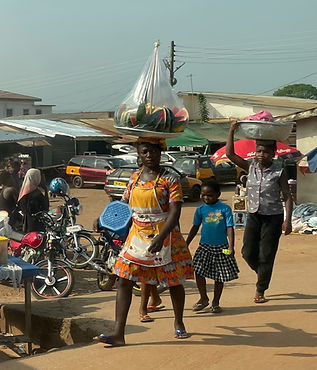
Ghana, Gifty and Pierce Brosnan's Trainers
Ghana surprised me in many ways. Positively. Call me weird, but I consider it my first visit to what I consider the “true” Africa. Yes, I have been to Egypt and South Africa, but this felt different. Egypt has always been more about pharaohs, and South Africa has been limited for me to Kruger National Park and white kids from Cape Town.
So why Ghana specifically? I once met a woman from Ghana. We worked together at a small hotel in Wimbledon. She was the head housekeeper and mad as a hat. She had an amazing energy and very infectious laugh. She also melted Pierce Brosnan's trainers in a washing machine.
Gifty was her name, and unfortunately we lost touch. So when I saw the trip, I grabbed the opportunity. And the trip confirmed something I had suspected: women from Ghana are bosses. Strong, sharp, glamorous and always ready to smile.
The tour was a round trip through the southern part of the country and included many different activities. Not promoting the company here, just stating a fact. The tour leader was very informative, so informative, in fact that I did not manage to write down half of what he said.

Arriving
One of the first things you hear around is the word "agoo", and you answer "amee". "Agoo" when you're trying to get through a crowd and need some space. "Agoo" when you're trying to get someone's attention. "Agoo" when you're a tour guide and your group of tourists is all over the place, chatting, taking pictures, staying behind and not paying attention to you. "Amee" when you're acknowledging that you’ve heard and are ready to listen.

We started off in Accra. I landed a day before the trip started, just to get the feel for the place. Of course, the temperature hit me first: 29 degrees at ten in the evening.
I picked a hotel just a 15-minute walk from where I was supposed stay with the group. Urbano hotel on the Oxford Street. Roosters woke me up at 4.
Simple life still takes place in cities, even a big one like Accra.
What I saw in Accra
When you arrive in Accra, don't leave straight away. The city can be overwhelming, I am the first one to admit that. However, it is so different from anything I have seen before, it definitely deserves a walk.
Both of my hotels in Accra were in proximity to the Oxford Street. It is a good place to start: maybe a short stroll, a peek into some shops, a meal in one of the restaurants.
Of course, I was lucky to be in Ghana with a group. Otherwise, I don't know if I would have had the guts to see all the places by myself. The downside of being a female traveller and a bit of a scaredy-cat.
Jamestown
Let's start with Jamestown.
One of the most recognisable buildings there is the lighthouse. If you're ever lost, ask how to get to the lighthouse. It's just a simple red-and-white tower, but everybody knows it.
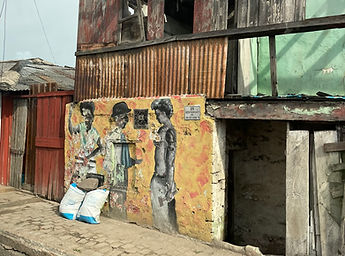
The area grew around two communities, a British and a Dutch one, and to this day people talk about the border that runs along the street. This part of town, the oldest one, is also one that is least developed. A maze of walkways that, historically, people used to run away and hide from their colonial persecutors. If you don't know the area, you will be lost after three turns.


Even with our guide, Isaac, it felt very intrusive walking around there. He said that as long as we are respectful and didn't take pictures without asking, it was fine because those communities are very welcoming and want the tourists to see and experience their lives.
The same thing happened at various markets that we visited. Once we started chatting with people, they were happy to pose for a few pictures. Sometimes we bought something in return.
Although I was not prepared for some aspects of poverty I witnessed. People sleeping in the market buildings on the sides were not a surprise. No, it was the women that were washing their intimate areas there that caught me off guard. They were trying to hide, but there was nowhere to hide.
Fantasy Coffins
While you're still in Accra, you have to visit Fantasy Coffins. This company was even mentioned on QI, the British panel show, so I was very excited to go and sample their products.
As you can imagine, they produce coffins. What sets them apart are the designs. For example, I have gotten inside a chili (see pictures), but there are plenty other ones like a LEGO block, or Coca Cola bottle, a bundle of cash, a truck, a lion, basically anything you can imagine and ask the guys to build.
Although the topic is gloomy, it was fascinating to see.

Beyond Accra
So what else is there to do? Well, plenty.
Bonkro Jungle Reserve
One of the more interesting activities was a visit to a jungle reserve. The tour operator that facilitated our trip was Ashanti African Tours. They do a lot of collaborations around the country. One of them was with a little community of Bonkro on the border of the woods, where a rare bird, the Picathartes, can be found.


To protect it, they have negotiated with the village to create a reserve. In exchange, they built a school for local kids and a small retreat for tourists who could stay there, visit the jungle and take part in activities organised by the community. Like riding a bike, visiting the cacao farm, planting trees, having a cooking lesson and even watching a movie outdoors with the villagers.
All this made it possible for me to connect more closely with the community, see how they live.
On a very sweaty night walk in the jungle, apart from seeing way too many insects, we got to see a white-bellied pangolin high up in a tree, going about his business. We lost the track of time a bit, but we might have spent good half hour just taking pictures.

The following day, we went on another little trek, this time up a hill. There is a massive rock that looks a bit like the Millennium Falcon, and under that rock there are four nests. This is one of the very few places in Ghana where you can actually see the reclusive white-necked Rockfowl (Picathartes).

We had to be very patient and quiet, as the birds are shy and scare easily. We waited motionless on a bench for 20 minutes until the first one showed up. It got scared and flew away. About 10 minutes later, two more came. This time they stayed, played around a bit and went into their nests.
Of course, we got our pictures but because of the fading daylight, many of them came out poorly.
Glass Beads in Krobo
Through the travel company, we also got to visit a place that recycles discarded glass and turns it into beads. Waste is an environmental problem in Ghana. I had only heard about it in documentaries; it's not something that gets told or shown to tourists. So any initiative that can recycle at least some of it is important.
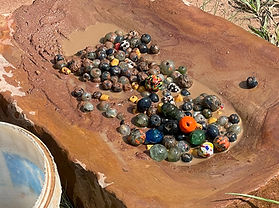

Our guide told us that beads are an important part of Ghanaian culture. Some are worn by women, hidden around the waist as an expression of femininity and modesty. Practically, they can also help keep an eye on posture and weight. Many men wear beads on their wrists, often a sign of their status in the community and their ethnic group.
The beads are very colourful, and each is slightly different from the other because they are all made by hand.
The facility we visited is in Krobo, and we got to watch the whole process: turning glass into colourful powder, designing, baking, polishing and finally making bracelets and necklaces.
We also got to try the last part ourselves. They sat us around a big table, with hundreds of beads spread out, and let us get to work. I managed to make two, and I must proudly say they weren’t that different from the ones we could buy in the gift shop.
The Country
Ghana is a proud nation. It has been through a lot throughout its history. I don't have the space or the knowledge to explain the complexities of a country that gained its independence from colonial rule after centuries of exploitation of its land, people and resources, as well as the manipulation of existing ethnic tensions and intercommunal conflicts.

Because Ghana is not one nation. It's many. Multi-ethnic, multi-linguistic and multi-religious. They still have their kings and queens, traditions and festivals. I only got to see a small percentage of that.
As I am just an outsider writing about a country I only visited for a short time, I can only convey my observations and sprinkle on top some facts I heard from our tour guide or was able to find online.

From Gold Coast to independence
The first Europeans to arrive were the Portuguese in 1471. They built Elmina Castle and started trading in gold they found there. Ghana later became known as the Gold Coast. Soon others showed up: the Dutch, the Danes, the Swedes, the Prussians and the British.
In 1874, the Brits had either seized or bought territories from the others and created the Gold Coast Colony. On 6th March 1957, the colony became independent, with Kwame Nkrumah as its first prime minister, later to be elected the first president. There is, of course, a museum and mausoleum dedicated to him in Accra, so clearly he was a big and important figure in Ghana.
And everybody loved him.
Well, no.
Nkrumah
These days Kwame Nkrumah seems to be revered in Ghana. Initially, he wanted to be a priest, but he went on to study in the US, including economics, sociology, geology and philosophy. He wanted independence for his country, so he created his own Convention People's Party, which strongly criticised British rule. Of course, he got arrested and spent three years in prison.
He became Prime Minister in 1952 and was the force behind Ghana's independence in 1957, the first country in sub-Saharan Africa to achieve this. In 1960, he was elected the first president.


His views were primarily socialist and nationalist, although he was also a strong advocate for the Pan-African movement. He wanted African countries to gain political and economic independence and argued against continued dependence on foreign aid while the continent had access to so many natural resources.
Under his rule, the state invested heavily in education, industry and energy projects. His ambitions were big. However, the reality turned out to be not as rosy. His government became authoritarian, and it was during his rule that Ghana became a one-party state. His vision of scientific socialism became known as Nkrumahism.
All that led to a coup d'état by the military and, allegedly, the CIA. No surprise there, knowing the CIA's history of meddling in other countries.
Nkrumah was in Vietnam at the time and was never able to return to Ghana while he was alive. He lived in Guinea, but died in Bucharest of an apparently incurable disease.
Years later, Ghanaians decided to bring his body back to the country and bury him in his home village. In the end, it was decided to create the Kwame Nkrumah Memorial Park and Mausoleum, where he is resting now after his third burial. His Egyptian wife has her grave there as well. Some trees in that park have been planted by famous personalities, Nelson Mandela among others.

Definitely someone worth looking more into if you're interested in modern history.

The Flag
Now to the flag.
Designed in 1957 to replace the flag chosen by the UK, it consists of three horizontal stripes and a five-pointed black star in the middle. The red represents the blood of those who died in the fight for independence. Gold stands for the mineral wealth of the country and green for its rich forests.
The star comes from the Black Star Line shipping company, created by Marcus Garvey, who supported the Pan-African movement and promoted Black self-determination. It represents emancipation and unity against colonialism.
Where Ghana got its name
Now to the name.
There used to be an ancient Ghana Empire in the western part of Africa, also known as Ghanata or Wagadu, which existed from the 3rd century until about the middle of the 13th century. Most of what we know comes from contemporary Arab historians.
The word ghana itself meant warrior or war chief. The rulers were called Kaya Maghan, King of Gold. The republic adopted this name to evoke the status of African kingdoms before colonisation began.

Women of Ghana


Streets of Ghana


Animals of Ghana


Landscapes of Ghana


My adventures


